

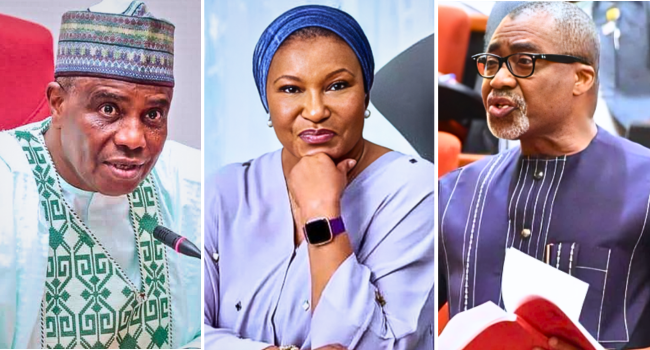

Nine Nigerian Senators Join ADC in Major Political Realignment
Nine members of the Nigerian Senate have officially left their former political parties to join the African Democratic Congress (ADC), signalling a notable shift in the country’s political landscape ahead of the next election cycle.
The announcement was made during plenary when Senate President Godswill Akpabio read out letters submitted by the lawmakers informing the chamber of their decision to switch political affiliation.
Senators Who Joined ADC
The lawmakers who moved to the ADC come from several opposition parties:
Aminu Waziri Tambuwal – Sokoto South (from Peoples Democratic Party)
Mohammed Ogoshi Onawo – Nasarawa South (from PDP)
Binos Dauda Yaroe – Adamawa South (from PDP)
Austin Akobundu – Abia Central (from PDP)
Lawal Adamu Usman – Kaduna Central (from PDP)
Ireti Kingibe – Federal Capital Territory (from Labour Party)
Victor Umeh – Anambra Central (from Labour Party)
Tony Nwoye – Anambra North (from Labour Party)
Enyinnaya Abaribe – Abia South (from All Progressives Grand Alliance)
Reasons for the Defection
While presenting one of the letters, Akpabio quoted Tambuwal, who attributed his departure to prolonged internal disputes within the PDP. According to him, disagreements among party leaders, legal battles, and factional divisions have weakened the party’s cohesion and made it difficult for him to remain active within its structure.
The Senate leadership also stated that Abaribe’s situation would be reviewed, giving him one week to reconsider his move. Questions have been raised over whether the circumstances surrounding his removal from leadership structures in APGA in 2025 meet constitutional conditions that allow lawmakers to defect without losing their seats.
Impact on Senate Party Strength
Following the defections, the distribution of seats in the Senate has changed:
All Progressives Congress – 85
African Democratic Congress – 9
Peoples Democratic Party – 8
New Nigeria Peoples Party – 1
National Democratic Coalition – 1
All Progressives Grand Alliance – 1
Social Democratic Party – 1
Three Senate seats remain unoccupied following the deaths of Barinada Mpigi, Godiya Akwashiki, and Okey Ezea.
Political Implications Ahead of 2027
The movement of the senators is particularly significant because recent political defections in Nigeria have largely favoured the ruling All Progressives Congress. This latest shift, however, strengthens the ADC as an emerging opposition platform.
The development is linked to a coalition of opposition leaders who adopted the ADC in mid-2025 as a political platform to challenge the ruling party in the 2027 elections. Notable figures associated with the coalition include Atiku Abubakar, Peter Obi, Rotimi Amaechi, Nasir El‑Rufai, and David Mark.
Meanwhile, Bola Ahmed Tinubu, Nigeria’s president, has rejected claims that the country is drifting toward a one-party system, maintaining that Nigeria remains a functioning multiparty democracy.
Election Timetable for 2027
The Independent National Electoral Commission (INEC) has also released a revised timetable for the 2027 elections following the passage of the Electoral Act 2026.
Under the new schedule:
Presidential and National Assembly elections – January 16, 2027
Governorship and State Assembly elections – February 6, 2027
The adjustment was made to prevent the polls from coinciding with the Ramadan fasting period.
Party primaries are expected to take place between April 23 and May 30, 2026, while political parties must submit their candidates between June 27 and July 11, 2026.
Campaigns for federal positions will officially begin on August 19, 2026, and the updated voter register is expected to be published by December 15, 2026.